Maud’s Secret Return to Bartram-Haugh
Uncle SilasMaud’s Secret Return to Bartram-Haugh turns an announced journey to France into a clandestine return and imprisonment. Silas presents the move as an urgent response to financial danger and entrusts Maud to Madame de la Rougierre, but the journey ends at Bartram-Haugh, where locked doors and barred, fastened windows expose the house as a place of deliberate confinement. The room’s resemblance to the setting of Mr. Charke’s death also brings an earlier apparent locked-room mystery into the later plot of Maud’s captivity.
The Journey Presented as Escape
The deception begins with an order delivered as if it were an emergency travel arrangement. Mary Quince is summoned to Silas’s room and returns to tell Maud to dress for a journey within half an hour. Maud is relieved by the prospect of leaving Bartram-Haugh and hopes to join Milly, but she does not know whether Mary Quince will be permitted to accompany her. Silas’s instructions make the arrangement seem settled and practical: Maud is to go to her daughter at a pension in France, with Madame de la Rougierre as escort.
Silas dictates the route and controls what Maud can communicate. She is to pass the night in London, continue to Dover the following night, and cross by mail-packet. He orders her to write to Monica Knollys, reads the letter before it is sent, and specifies a further note to Lady Knollys that Madame is to inspect. The letters are to suggest that Maud is travelling to France while withholding the address; Silas says that secrecy is important to his safety and attributes the abrupt departure to the threat of an execution against the house. His stated plan gives the journey a plausible destination and explanation, while leaving Maud with little independent control over its arrangements.
Madame’s authority is made explicit before they set out. Silas tells Maud that Madame is not merely her attendant: she is to direct every detail of the journey and make its necessary payments, and Maud is to obey her instructions. Thus the apparent protection of an escort is also the means by which Maud is placed under Madame’s control. The carriage leaves with Madame and Maud together, while the letters and the carefully prescribed itinerary prepare others to believe that Maud is going to France.
The Destination Revealed
During the journey, Maud struggles to stay awake and later suspects that something in her tea may have contributed to her drowsiness. She is asleep when the carriage reaches its destination. On arriving, she finds herself in darkness with Madame, who explains that it is after three o’clock and lights the way inside. The building initially passes as a hotel, but its silence and unfamiliar surroundings do not reassure Maud.
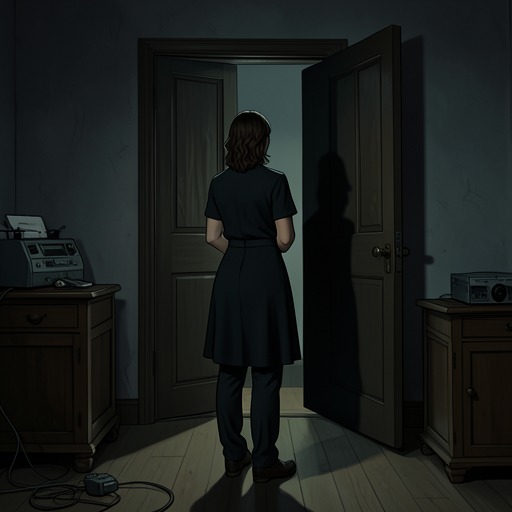
Madame leads her to a large, shabby bedroom furnished with an old four-poster bed and sparse furniture. She locks the door and keeps the key, presenting this as her usual practice in a hotel. When Maud looks out of the window, she sees a stone quadrangle that immediately calls Bartram-Haugh to mind. She recognizes that the supposed hotel is in fact the inner court of the house she was meant to leave. Madame confirms the deception with laughter, making the reversal unmistakable: Maud has not been taken toward France at all but secretly returned to Bartram-Haugh.
The recognition turns suspicion into direct confinement. After Madame leaves, Maud tries the door and finds herself locked inside. She discovers iron bars fixed across the accessible bedroom window; the windows are screwed shut as well. These precautions are not general features of the house but are confined to the windows available to her, and Maud understands that the bedroom has been made into a prison. The journey that appeared to promise separation from Bartram-Haugh has instead delivered her into a more tightly controlled part of it.
Bartram-Haugh’s Enclosed Spaces
The return acquires additional force from Maud’s earlier experience of the house. When she first arrives, Bartram-Haugh’s grand architecture is already set against visible neglect: its white stone front is stained and moss-grown, weeds spread through the grounds, and storm-felled trees lie in the courtyard. Inside, locked doors, closed shutters, and high barriers restrict exploration. The building’s scale does not make it open; its corridors and rooms repeatedly impose limits on where Maud and Milly can go.
Maud and Milly had also found an inner quadrangle in a neglected part of the house, reached after climbing a steep back stair. Its dark, dirty windows, moss and weeds, and little evidence of human use make it feel cut off from ordinary household life. When Maud later recognizes the quadrangle from the room where she is confined, the architectural resemblance links the secret destination to the house’s concealed interior spaces. The recognition depends on a specific feature of Bartram-Haugh, not simply on a general resemblance between old buildings.
That space also recalls Mr. Charke’s death. Maud had previously identified the chamber in which they stood as the room where Mr. Charke had killed himself, pointing to panelling that had been pulled from the wall. The earlier inquest had treated the room as secured from within: the window was fastened, the door locked with its key inside, and no entry route could be found through the chimney or walls. The apparent impossibility of access had helped support the conclusion that Mr. Charke died by his own hand, even as doubts and scandal persisted.
The Later Solution to the Closed-Room Mystery
Maud’s imprisonment gives new significance to the house’s windows. During the later attack on her room, she witnesses Dudley Ruthyn descend by rope to the window and open the bars and window together as a single section. This is not an ordinary entrance but a concealed mechanism, and it shows that the room’s visible barriers can hide a route of access. The incident makes the earlier claims that a room was securely closed less conclusive than they first appeared.
After Lady Knollys describes Dudley’s entry, Doctor Bryerly examines the windows in the room where Mr. Charke had slept. He finds powerful steel hinges concealed within the timber of the window-frame. An iron pin on the outside secures the window, and removing it allows the window to swing open. The room in which Maud had been confined is the same room in which Mr. Charke died; the concealed hinges provide the access that the earlier investigation failed to discover. This later examination solves the apparent locked-room puzzle without changing the inquest’s documented observations that the door and window had seemed secured from inside.
Significance and Consequences
The false journey transforms Bartram-Haugh from the place Maud is relieved to leave into the place where her movement is most severely restricted. Silas’s travel instructions, the letters he supervises, and Madame’s delegated authority make the return possible under the appearance of legitimate guardianship and ordinary travel. Once Maud recognizes the courtyard, the locks and window bars reveal the practical meaning of that arrangement: she has been brought back without being told the destination and confined in a room designed to prevent her departure.
The episode also joins Maud’s present danger to the unresolved history of Bartram-Haugh. The same house contains the chamber associated with Mr. Charke’s supposed suicide and the concealed window mechanism that eventually accounts for entry into it. The architecture first appears to prove that no outsider could have entered; later, its hidden construction overturns that inference. Maud’s return therefore marks both an intensification of her captivity and a turning point in the novel’s treatment of the house’s closed rooms: barriers that seem to establish safety or impossibility may conceal the means by which control and violence are exercised.